Showing posts with label John Lennon. Show all posts
Showing posts with label John Lennon. Show all posts
Monday, September 23, 2013



Friday, September 6, 2013
The Beatles 'Abbey Road Medley' stripped down to just the vocals
I implore you all to set aside 16 minutes of your day/night to listen to this. It's a vocals only version of The Beatles' famous "Abbey Road Medley" from the finale of Abbey Road, and it just reassures me (and hopefully you) that they could all sound amazing across a variety of songs and Paul, John, George, and even Ringo could harmonize better than anyone. Press play below to listen, and I'm sure you'll start singing along in no time.
Wednesday, June 26, 2013
Sunday, July 15, 2012
Beatlemania Now photos
As for the show, it was great! Would absolutely go back to see them. The musician "playing" Paul McCartney was phenomenal; he replicated his mannerisms and playing style perfectly. Ringo was on point and John Lennon was pretty good as well, could have done better in the vocals but otherwise great. The musician mimicing Harrison, as he was with the actual Beatles, stayed mostly in the background but provided great guitar work.
 |
| All You Need is Love |
 |
| I Am the Walrus (G'goo goo g'joob!) |
 |
| Revolution 1 |
 |
| Get Back |
 |
| Imagine |
Thursday, April 5, 2012
Behind the scenes of the Sgt. Pepper album cover
Ever wonder who all those people were on the famous cover of the Beatles' Sgt. Pepper's Lonely Hearts Club Band?
Eddie Deezen offers some background information about the album cover; read some below and continue over at Neatorama:
It is the most famous rock album cover of all time: The Beatles’ Sgt. Pepper’s Lonely Hearts Club Band. One of the many things that still fascinate us about this incredible album is the cover. The concept for the cover was called “people we like.”
According to artist Peter Blake, the designer of the iconic Sgt. Pepper cover: “In my mind I was making a piece of art rather than an album cover. It was almost a piece of theater design.”
Blake continues: “I offered the idea that if they had just played a concert in the park, the cover would be a photograph of them with the group who had watched the concert. If we did this by using cardboard cutouts, it could be whomever they wanted.”
Each of the four Beatles was told to compile a list of people they admired, and their choices would all be featured on the album’s cover. Ringo, always the least pretentious of the four, declined right off the bat. “Whoever the others choose is okay with me,” Ringo said.
John Lennon’s off-kilter mind immediately came up with Adolf Hitler and Mohandas Gandhi. Hitler was immediately nixed for obvious reasons. But, incredibly, a paper cutout of Adolf Hitler was actually made and was there at the photo session on March 30, 1967. Legend has it that Hitler was actually in the final shot, but during the session, one of the Beatles stood in front of him, covering the camera’s view. Gandhi got the axe by EMI executives, believing it would hurt album sales in the Far East.
George, “the mystic Beatle,” of course, chose four Indian gurus. Bob Dylan was a clear choice by all the Beatles, who worshiped Dylan.
Fred Astaire was definitely a “Paul” choice. The legendary dancer was an easy sell and was reportedly delighted to be featured. However, despite Paul’s initial assurance to EMI that all the requested “guests” would “love to do anything to please us,” several of the chosen figures gave EMI more than a bit of difficulty. Shirley Temple asked to hear the finished product produced before giving her consent.
The Beatles all wanted Mae West to be on the cover, but she was apprehensive. “What would I be doing in a lonely heart’s club band?” Mae asked. To placate the legendary sex symbol, all four Beatles wrote and signed a letter to Mae, and she finally agreed.
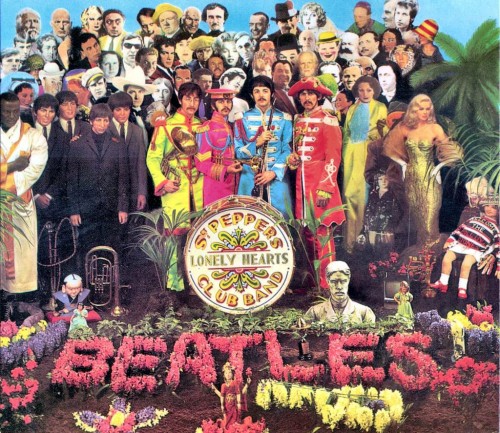 |
| Yep, these people. |
It is the most famous rock album cover of all time: The Beatles’ Sgt. Pepper’s Lonely Hearts Club Band. One of the many things that still fascinate us about this incredible album is the cover. The concept for the cover was called “people we like.”
According to artist Peter Blake, the designer of the iconic Sgt. Pepper cover: “In my mind I was making a piece of art rather than an album cover. It was almost a piece of theater design.”
Blake continues: “I offered the idea that if they had just played a concert in the park, the cover would be a photograph of them with the group who had watched the concert. If we did this by using cardboard cutouts, it could be whomever they wanted.”
Each of the four Beatles was told to compile a list of people they admired, and their choices would all be featured on the album’s cover. Ringo, always the least pretentious of the four, declined right off the bat. “Whoever the others choose is okay with me,” Ringo said.
John Lennon’s off-kilter mind immediately came up with Adolf Hitler and Mohandas Gandhi. Hitler was immediately nixed for obvious reasons. But, incredibly, a paper cutout of Adolf Hitler was actually made and was there at the photo session on March 30, 1967. Legend has it that Hitler was actually in the final shot, but during the session, one of the Beatles stood in front of him, covering the camera’s view. Gandhi got the axe by EMI executives, believing it would hurt album sales in the Far East.
George, “the mystic Beatle,” of course, chose four Indian gurus. Bob Dylan was a clear choice by all the Beatles, who worshiped Dylan.
Fred Astaire was definitely a “Paul” choice. The legendary dancer was an easy sell and was reportedly delighted to be featured. However, despite Paul’s initial assurance to EMI that all the requested “guests” would “love to do anything to please us,” several of the chosen figures gave EMI more than a bit of difficulty. Shirley Temple asked to hear the finished product produced before giving her consent.
The Beatles all wanted Mae West to be on the cover, but she was apprehensive. “What would I be doing in a lonely heart’s club band?” Mae asked. To placate the legendary sex symbol, all four Beatles wrote and signed a letter to Mae, and she finally agreed.
Wednesday, March 7, 2012
Art in the eye of a needle
Miniature scultpures are nothing new in the art community (see my previous post on pencil art), but these sculptures done in the eyes of needles up the ante. They're from Willard Wigan, and they're truly amazing. Check out a few examples below, then see more at Buzzfeed.


Thursday, February 16, 2012
The Beatles considered reuniting
Several times, actually. From Rolling Stone:
The Beatles had considered getting back together while all four members were still alive, says Paul McCartney. "There was talk of re-forming the Beatles a couple of times," he tells Rolling Stone, "but it didn't jell, there was not enough passion behind the idea."
According to McCartney, the band was very pleased with having come full circle creatively, and worried about tainting their legacy. "More importantly, it could have spoiled the whole idea of the Beatles, so wrong that they'd be like 'Oh, my God, they weren't any good,'" he says. "The re-formation suggestions were never convincing enough. They were kind of nice when they happened – 'That would be good, yeah' – but then one of us would always not fancy it. And that was enough, because we were the ultimate democracy."
Thursday, January 26, 2012
The origin of The Beatles' bowl cuts
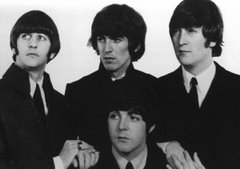 New York Press Conference 1964 Reporter: Where do your haircuts come from?
George Harrison: Our scalps.
In their early years as a fledgling rock and roll band in the late 1950s and into the early 1960s, The Beatles each sported typical slicked-back, greased-up Tony Curtis/Elvis Presley type D.A. haircuts. In an early explanation as to the origin of the Beatles haircut, George was quoted as saying that he came out of the swimming baths one day, his hair had fallen down over his forehead, and he just left it that way.
The true derivation of the world famous coiffure is a bit more complex. In August of 1960, the newly-named “Beatles” consisted of five members: John Lennon, Paul McCartney, George Harrison, bassist Stu Sutcliffe, and a newly-hired drummer named Pete Best. The band was hired to play as series of gigs in August of 1960 in Hamburg, Germany. It was there that they met two people who were to have a profound effect on their future careers as icon and trendsetters: Astrid Kirchherr and Jürgen Vollmer.
Read the rest exclusively at Neatorama!
Read the rest exclusively at Neatorama!
Subscribe to:
Posts (Atom)